

Amplifying the human brain with AI.
A system built for one specific person, that grows with them over a lifetime. Software on your laptop first, a device in your ear next, and finally a full connection between AI and your mind.
Be among the first people it is built for.
Take it in, turn it over, put it out
A podcast, a course, a paper, or one sentence in a meeting that turns out to matter months later.
It sits with everything you already know, until a situation shows up and the pieces come together.
The idea, the decision, the product, and eventually the company you end up building out of it.
Everything you have ever built came through those three. It is the one part of your work that cannot be bought, copied, or delegated.
Three places your best work is lost
The same thing causes all three, and none of it is about effort.
It never started
The material you chose is still waiting. Depth costs everything at the front and returns nothing for weeks, while everything else within reach returns something immediately. That is why the work with the highest return is the work that never gets started.
You went in circles
You spent a week inside a problem, certain the answer was in there. What would have moved you was one precise question at the right moment. Nobody around you could ask it, and from inside the problem neither could you.
It never got out
Your best thinking this week happened while you were moving. Holding on to it meant stopping everything and dictating into a phone. It did not survive the walk, and by the evening all that was left was knowing something had been there.
It is not laziness. It has a name.
You had the time. You knew roughly what to do. It did not happen.
What stops you is never the work itself. It is everything standing in front of it and inside it: starting it, getting far enough in to think properly, staying there, and finishing the version that is actually good.
Every one of those is a point of refusal, and refusing at one of them is enough to ruin the whole working day. The name for that is friction, and it is where the years go.
Friction goes away in exactly two states
On a walk, in the shower, on a train with nothing to do. The thinking happens on its own, at a level you cannot force at a desk.
The night before it matters. Work that sat untouched for weeks gets done in one sitting, and it gets done well.
Neither one arrives on command. What can be done is to know which state and which process you are in, and to put the right thing in front of you while it lasts.
AI did not make the work easier. It made skipping it easier.
Ask, and an answer arrives in seconds, good enough to use. Doing the same work yourself costs exactly what it always did. The answer wins every time, and it is almost never read closely.
The work gets delivered. What does not happen is any of it going into you.
You keep the feeling of having covered it and none of what was underneath. Nothing writes that down, so nothing stops it growing.
That is what the debt costs. It does not show up this month. It shows up in five years, in somebody who knows a great many things approximately and nothing well enough to build on.
The intelligence was supposed to be yours
What is on offer everywhere is a second brain, sitting beside yours. It is enormously capable, and it was built for everybody.
It thinks in your place. The hard part was holding a problem in your head until it moved. Handing that over is easy, and the part of you that does it goes quiet.
It gives you the middle. However you prompt it, what comes back is the average of everything already written. Your version of the answer was the only one that was going to be new.
It agrees with you. It tells you the plan is strong. It has never looked at your work honestly from the outside and told you where you are wrong.
Garry Tan, CEO of Y Combinator, said it simply: intelligence is getting cheap, and it should be personal. One model serving eight billion people cannot hold what any single one of them is.
You did not want a second brain. You wanted the capability in your own head, where it goes wherever you go and stays after you stop paying for anything.
Everybody is racing to build a superintelligence you can stand next to. The one worth having is the superintelligence inside you: your brain and the machine joined into one thing, so the part that got stronger is yours.
Not a feeling of being sharper. You take the offer. You start the company. You produce work nobody else could have produced, and you can account for every step of how it happened, because what improved was you.
There is something you said you were going to build. It runs on how well you think.
Built for one person, and that person is you
The whole job of this system is to make one specific person better at the work only they can do.
It runs on your laptop, and nothing in it is shared with anybody else.
What it reads
What you opened, how far you actually got, and the part you skimmed. The useful signal is the gap between what you meant to take in and what went in.
When the work is moving and when it has stopped, read from how you actually work rather than from what you would report. Nobody is a reliable witness to their own concentration.
From what you already wear. Sleep, recovery, heart rate, movement. It is how it knows whether this is an hour that can carry something difficult, or an hour to stay out of the way.
The goal in your own words, and the standard you are holding it to. Everything else is measured against that.
The more of it you connect, the better it gets, and none of it leaves.
You are walking and talking
You press the ring once with your thumb and keep walking, hands where they were. You talk the way you talk to somebody already in the context.
By the evening it is waiting, carried to a finished form, in your own voice.
You have been going in circles
What arrives is a question. Not an opinion, and not a finished answer landing on top of the one you were still forming. A question aimed at the thing you said you were trying to reach.
It comes back at the right minute
Something you took in returns at an hour when you can take it, tied to whatever is in front of you now. You say it back in your own words, and where you skate over the part you never really understood, it asks again in that exact place.
This time it stays.
Effortless, and that is the specification
Every step between having a thought and doing something with it is a place the thought can die. Whether the step is hard does not matter. It is a step, and there are always six of them.
So there is nowhere to click into. No folders, no notes, no feed, nothing to organise. The moment a product like this grows a library, the library becomes the work.
What it is for
You name the goals and the standard you are holding yourself to. The offer. The company. The work you have not made yet.
After that it is not measured in how sharp you felt. It is measured in how much closer you are to the goals you set, and how fast you are getting there.
Your best thinking does not happen at a desk
Software reaches you where you are sitting down. Every tool ever built for thinking lives there, and the state that produces your best raw material has never had anything in it at all.
So we are making the thing that goes with you.
Two in your ears, one on your finger
It sits in the ear and braces against it, so it stays where you put it when you move. Nothing about it looks medical, and it is meant to be seen.
One is enough to hear you and to speak to you. The second one is there for silence: when you need to work, the noise around you goes completely.
The ring is the trigger. One movement of your thumb and it is recording, with no phone, no screen and no wake word said out loud in the street.
Six steps and the idea stays on the pavement. One step and it comes home with you.

And then it stops carrying information
Contacts sit in the insert, and everything you already wear reports into the same place. At night your brain replays what it worked on that day, and that is when it is fixed in place. Something on your head at three in the morning has a say in what gets replayed.
That is where it stops carrying information and starts working on you.
The first series is 100 devices!
This goes into deep tech
The software and the earpiece are the first things we ship. They are not what this is aimed at.
A second line of work runs alongside them, and it is running now: reach the brain directly, instead of going around it through your eyes, your ears and your voice.
Three things that become possible
The Matrix showed it and everybody understood it in one second: you choose what to know, and then you know it. Not reading faster. Knowing, in a fraction of the time reading takes, and still knowing it a year later.
Not speech to text. Not text to speech. Thought to thought. Language is compression, and most of what you were holding does not survive it: the emotion, the experience, the taste of the thing. This is where that stops being lost.
Deep focus switched on because you asked for it. The state you cannot reach today on purpose, entered on purpose, and held for as long as the work needs it.
Some of the science this stands on is already published and has been replicated for fifteen years. Nobody has aimed it at one person's own thinking.
Some of it may not work. I am not giving dates, and anybody who gives you one is guessing. What does not change is the direction.
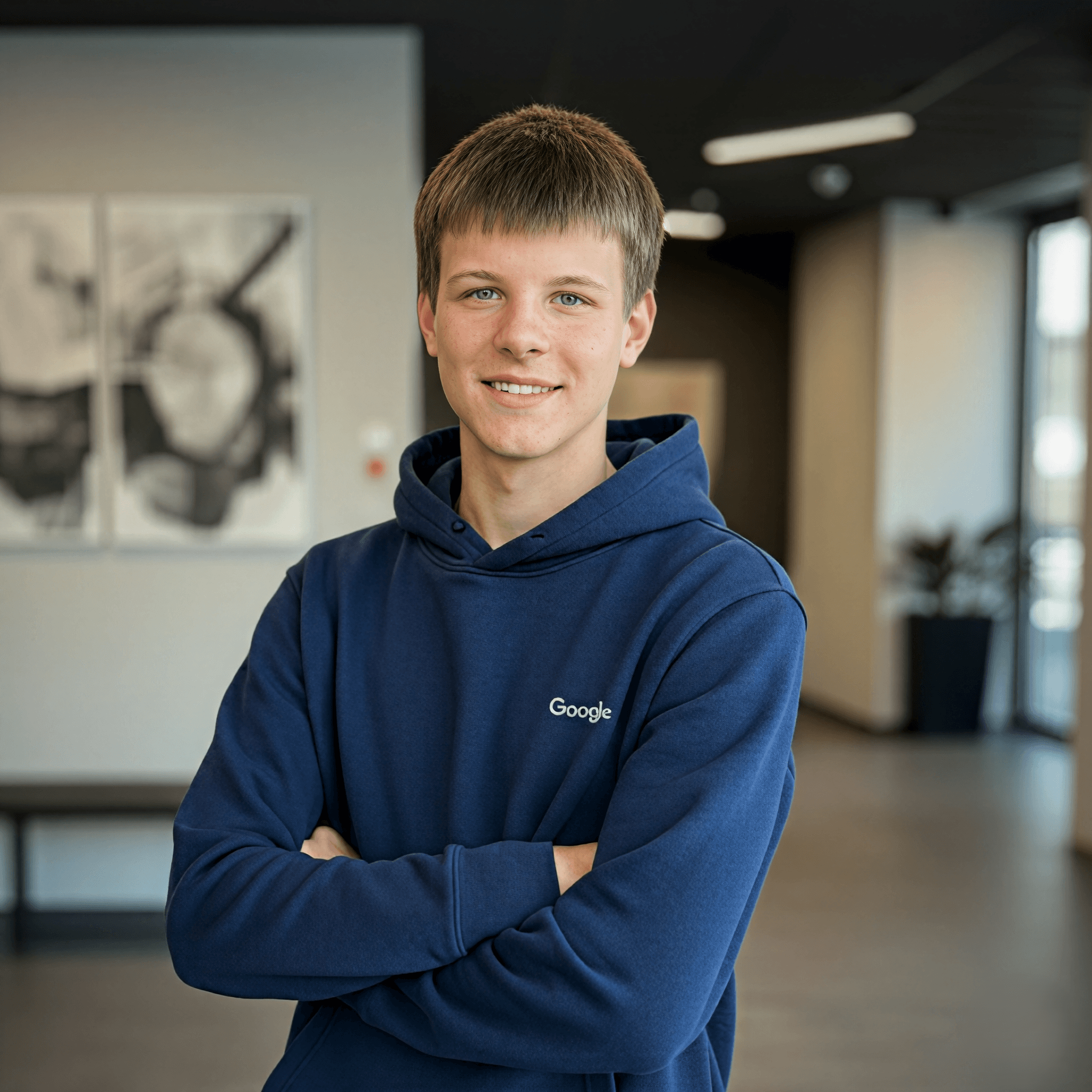
I am Serhii Kravchenko. I introduced the term The First Brain and published the manifesto behind it before any of this existed.
AI holds everything ever written and never gets tired. Your brain cannot do that and does not need to, because it is the only thing that has ever produced an idea nobody had before. Neither one turns into the other, and that is exactly the point.
Right now the most powerful technology we have is pointed at taking your attention, not at raising it. Recommendation feeds, ordinary machine learning, the thumbnail picked for you: all of it tuned by very good engineers so that you keep scrolling instead of doing the thing you sat down to do. It works, and that is the problem. Somebody decided that. It can be decided differently.
So aim it at your brain instead. Take what AI is good at, take what your brain is good at, and build one thing out of both. Not a place to store your thinking, but something that makes your thinking better and leaves it inside you.
The manifesto argues it in full. It is free and it takes nine minutes.
Come in
Be among the first people it runs on, and hold a place in the first hundred devices. Early access is free.
Nothing is charged, now or later, without you saying yes to it first.